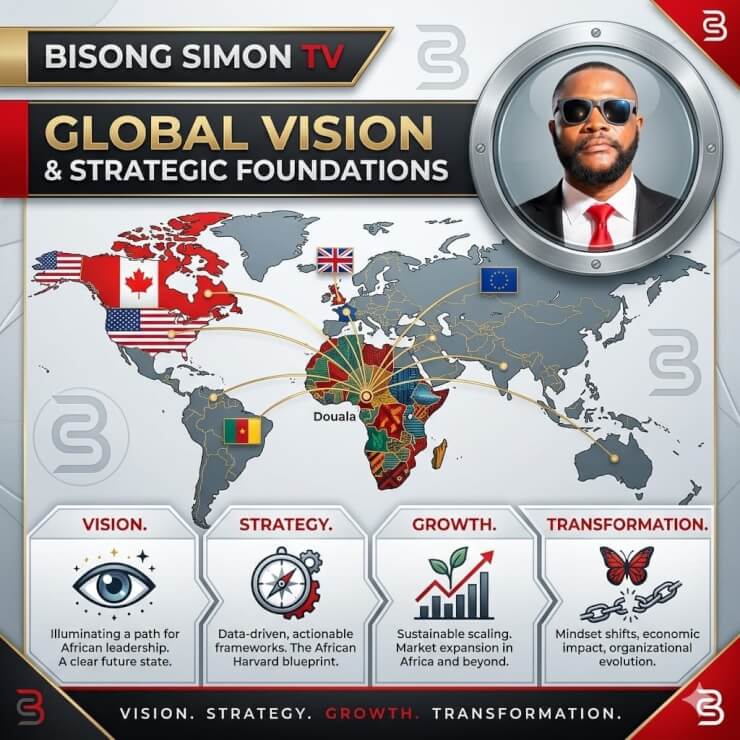
I am not building for the next 30 days. I am building for the next 30,000 years. Welcome to the future. Welcome to the reconstruction of the mind.
FrançaisJe ne construis pas pour les 30 prochains jours. Je construis pour les 30 000 prochaines années. Bienvenue dans le futur. Bienvenue dans la reconstruction de l'esprit.
The world expects you to be perfect. It expects you to be a machine. It demands that you apologize for your storms, hide your mistakes, and trade your integrity for a bill. I am not that person. I am an Architect. I am the Founding Director of BISONG SIMON TV™ — The African Harvard for Growth and Transformation. And I have made mistakes. I have gone the wrong way. I have had days where the fire felt like it was burning the house down.
Le monde attend de vous la perfection. Il attend que vous soyez une machine. Je ne suis pas cette personne. Je suis un Architecte, et j'ai fait des erreurs — mais j'ai appris que ce n'est jamais ce qui vous arrive qui détermine la qualité de votre vie, c'est votre réaction.
Many will never understand why I build. They look for immediate gratification, for the paycheck, for the applause. They do not understand that dreams are not found; they are manufactured. They take time, they take solitude, and they take a refusal to quit when the storm is at its peak. Solitude has shown me the real face behind the mask. Gold and silver are temporary, but the Institution — the legacy of the mind — is eternal.
If you are struggling in the dark, know this: you are not hunted; you are the Hunter. If you have missed your step, if you have been on and off, if you have drifted — do not judge yourself. Do not stay stuck in the contradiction. Correct it. At once. The moment you remember your purpose, you pick up the work. You do not wait for the perfect time. You do not wait for the mood. You build.
This volume — The Reconstruction of the Mind — is an original work, independently created and protected as the intellectual property of Bisong Simon Egoh, distinct from every other creation in this institution. The truth inside it is the only thing that protects it. This is my stand. Welcome to the future. Welcome to the reconstruction of the mind.
The world expects perfection. It expects you to apologize for your storms and hide your mistakes. This chapter, drawn from a story of surviving the hardest nights, rejects that expectation — because it is never what happens to you that determines the quality of your life, but how you react to it.
A storm you survive without apologizing for it is not a failure. It is the raw material of the Architect.
Name one storm in your life you have been quietly apologizing for. What would it look like to stop?
Write the difference between reacting to a crisis and being defined by it.
If you are a silent brother or sister struggling in the dark: you are not hunted, you are the Hunter. If you have drifted, do not judge yourself and do not stay stuck in the contradiction. This chapter, built on a collection of rewritten endings, teaches the discipline of correcting course the moment you remember your purpose — not waiting for the mood, the mentor, or the perfect Monday.
The moment you remember your purpose, you pick up the work. Correction that waits for the perfect time is not correction — it is postponement wearing a better name.
Name one place you have drifted "on and off" instead of committing fully. What would correcting it today look like?
Write the next page of a story you have been leaving unfinished out of fear.
If you're selling to women, sell them what success feels like. If you're selling to parents, sell them a break from their children. If you try to sell everyone the same message, you will end up selling to no one. This chapter, paired with a guide to AI prompting, teaches precision of message as a form of respect for the listener.
You do not need a louder message. You need the discipline to speak to one real listener instead of an imagined crowd.
Rewrite your last public message twice: once for a single named person you know, once for an imagined crowd. Which one is more honest?
Name the one feeling — not feature — that your work actually delivers to the person who needs it most.
Dreams are not found; they are manufactured. They take time, solitude, and a refusal to quit when the storm is at its peak. This chapter, drawn from the rise, fall, and comeback of a global icon, names the discipline of a Sovereign comeback — one built in private, long before it is seen in public.
A comeback rehearsed only in public was never a comeback. It was a performance waiting for the discipline behind it.
Name one comeback you are currently rehearsing only in private. What is the first public sign of it you are ready to show?
Write the exact discipline — not the story — behind the last time you truly rose after a fall.
Gold and silver are temporary, but the Institution — the legacy of the mind — is eternal. This closing chapter, drawn from a visionary journey beyond the veil, asks what you are actually building: something that ends when you do, or something that begins its real life after.
Anything that requires your presence to keep existing was never eternal. Build the Institution that keeps teaching after you have gone silent.
If your name were removed from everything you have built, what would still keep functioning? What would collapse?
Write the one piece of your work you believe could still be teaching someone in thirty thousand years.
Amara from Lagos just joined the BISONG SIMON TV™ network.
In which the cost of growth is counted, and paid.
Your own family will talk bad about you when you are in the process of breaking all their generational curses. Bisong had heard the sentence so many times in his own mouth that it had stopped sounding like a warning and started sounding like a fact of weather — something you dressed for, not something you argued with.
He had built platforms before this one felt like anything. Small rooms, small audiences, a camera propped on a stack of books. What no one told him was that the loneliest part of building an institution isn't the years of obscurity. It's the first year of visibility, when the people who share your last name start asking, quietly, why you couldn't just be content with what everyone else accepted.
He was not building a business. Not yet, not only. He was documenting a vision — the difference, he would come to insist, between a dream and an institution being that one is written down, licensed, and built to survive the person who had it. That was the whole of the problem he kept circling in every notebook: millions of creators with ideas and no structure to hold them. Ideas that stayed ideas. Talent, especially African talent, rich in every room and thin in the rooms that mattered — the publishing houses, the syllabi, the boardrooms where "education" got defined for the rest of the world.
Growth is not always celebrated, especially when it challenges long-standing patterns.
So he sat with the discomfort instead of running from it. He let the whispers be whispers. And in the space that used to be filled with needing to be understood, he started drafting something sturdier than an explanation — a plan.
In which the plan takes a shape that can be pointed at.
A vision without architecture is just a mood. Bisong knew this the way a builder knows a slope — not from theory, but from watching too many good ideas collapse for lack of a frame. So he gave his four walls names, and he gave the names jobs.
The Creators Academy™ would teach — not motivational noise, but structure: how to document a vision so it could survive being said out loud. The Creator Code™ would protect what got made — licensing, intellectual property, the unglamorous paperwork that turns a good idea into an asset instead of a memory. The AI Launchpad™ would be the skeleton, not the soul — technology in service of a story, never the other way round. And underneath all three, holding them level, sat The Blueprint™: fifteen laws, distilled from every mistake he'd made twice, about what makes an institution sovereign instead of merely successful.
He did not build this to compete with the rooms that came before him — the lecture halls of old universities, the stages of the inspirational circuit. He built it because none of those rooms were built to hold what he was trying to hand down. Coursera taught skills. TED spread ideas. Neither was in the business of legacy.
Vision, clarity, institution, legacy — he wrote the four words on the wall above his desk, in that order, because order was the whole argument. Skip a step and you get another good talk that fades by Thursday. Keep the order, and you get something that outlives the room it was born in.
In which Limbe stops being a starting point and becomes a center.
There is a version of this story where Africa is the market. Bisong refused that version on principle, and then on strategy. He had watched too many platforms arrive on the continent asking what it could consume. He wanted to ask, instead, what it had always produced — and had simply never been paid, credited, or licensed for.
He talked about the numbers the way other founders talk about weather — plainly, because they mattered but weren't the point. E-learning growing past what anyone could have called a niche. Publishing worth more than most people guessed. A creative economy on the continent that outside observers kept describing, in careful hedged language, as poised for a decade of growth. He read the projections the way he read scripture: as promise, not proof — something to build toward rather than something already delivered.
Africa's creative economy is not a market waiting to be discovered. It is a source that was never properly credited.
From Limbe, and later from a small stretch of coastline in La Manga, he built the same argument in two accents: that clarity travels, that an institution designed with rigor in one place could be licensed and rebuilt with the same rigor anywhere — Lagos, Boston, Mumbai, London. Not a franchise of inspiration. A franchise of structure.
In which a founder learns to plan past his own patience.
The first roadmap he ever drew was impatient, the way every founder's first roadmap is impatient. He tore it up. The second one he drew in three phases, and he made himself sit with each one long enough to be honest about what it would actually cost.
Years one and two: foundation. Not glamorous. The Academy opening its doors before it had a reputation to lean on. A pilot of the AI Launchpad that would embarrass him twice before it worked once. A first Clarity Summit, small enough to fit in a room, ambitious enough to be worth naming.
Years three through five: expansion, and with it, the discipline of saying no to shortcuts. Licensing the Creator Code to schools and companies who wanted the framework more than they wanted him personally in the room — proof, if it worked, that the institution could stand without its founder present. Regional summits. Translation. The unglamorous multiplication of infrastructure.
Years six through ten, he wrote more carefully than the rest, because this was the part that could tip into fantasy if he let it. Campuses. Global adoption. Endowment-style funding built to outlast any single year's revenue. He wrote projections beside each phase — modest at first, ambitious by the end — and beside them, in smaller handwriting, a note to himself: a scenario, not a promise. Build the thing regardless of whether the number lands exactly here.
In which the blueprint stops being about him.
He kept coming back to the same test, the one that separated an institution from a personality brand: could it survive him leaving the room? Not just financially — philosophically. Would the Fifteen Laws still make sense to a stranger who had never heard him speak?
He wrote the fifteenth law last, and it was the simplest: a sovereign system generates value without constant input. Everything before it was infrastructure for that one sentence. Documentation, so the vision didn't die with him. Licensing, so the value didn't require his signature on every page. Multiplication, so the teaching didn't require his voice in every room. Transparency, so the trust didn't depend on his charisma alone.
You can honor where you come from and still build something that no longer needs you standing in the doorway.
He thought, often, of the family who had once talked badly about the process of his becoming. He no longer needed them to understand it. He needed, instead, for the thing he built to be sturdy enough that their grandchildren could walk into a room bearing his name and find not a shrine to him, but a structure that worked — the way you don't need to know who engineered a bridge to trust it will hold your weight.
That was the legacy work. Not the applause. The bridge.
Ten slides. One thesis: clarity, documented and licensed, becomes an institution built to outlast its founder.
The full case for the African Harvard for Growth & Transformation: the problem creators face, the four pillars of the ecosystem, the roadmap, and how the institution sustains itself. Illustrative projections are marked as scenario planning, not audited figures.
All 10 Slides
In which an idea learns to hold its own shape.
A lawyer once told Bisong that intellectual property was just a fence around a field. He didn't fully believe her until he watched a creator's course notes, unlicensed and unprotected, get copied word for word by someone with a bigger platform and no memory of where the words had come from.
The Creator Code™ was built out of that small, ordinary theft. Not out of paranoia, but out of respect for the fact that a written idea is still property, even when it arrives as a video, a workshop, a framework sketched on a napkin. He taught creators to document first and publish second — dates, drafts, licenses — so that the fence went up before anyone needed it.
It was unglamorous work. Nobody dreams of clauses. But he had watched too many bright ideas evaporate the moment they left their creator's hands, and he had decided that the opposite of evaporation was paperwork done early and done well.
In which the scaffolding is finally named, end to end.
He had been writing the Fifteen Laws for two years without calling them that. Documentation. Licensing. Clarity. Sovereignty. Attention, engineered rather than begged for. Longevity. Identity. Structure. Transformation. Transparency. Multiplication. Globality. Relevance. Legacy. And beneath all of them, holding the floor up: sovereign systems, built to generate value without his constant hand on the lever.
Personal vision. Documented clarity. Licensed institution. Global legacy.
He printed the list once, taped it above his desk, and realized it read less like a business plan than a confession — every law was a mistake he had made and did not intend to make twice. That was the closing of the first act: not a triumphant unveiling, but a quiet admission that the blueprint was, at last, complete enough to hand to someone else.
In which a small room in Limbe becomes a rehearsal for something larger.
The first Clarity Summit™ fit forty chairs, and eleven of them were empty. The projector failed twice. The AI Launchpad™ demo he'd promised would "change how creators launch overnight" froze on a loading screen for eight seconds that felt like eight minutes.
Nobody in that room mistook it for TED. But three creators left with signed licensing agreements, and one of them, a self-published author from Douala, would later credit that failed projector and all, with the first structured plan she'd ever made for her own work.
He learned that day that a summit's job wasn't to be flawless. It was to be the first proof that the room could hold more than one voice — his — and still function.
In which friction is chosen on purpose.
He was advised, more than once, to make the Institutional Framework Licensing easier to buy — automated checkout, instant approval, every convenience the rest of the internet had trained people to expect. He refused, and required bank-to-bank transfer instead.
It was not efficient. He knew that. But he wanted the friction, because he had watched impulse purchases produce impulse relationships — customers who vanished the moment the excitement faded. The manual transfer was a small, deliberate obstacle, and the people willing to clear it turned out, almost without exception, to be the people serious enough to still be there a year later.
Not every filter is a barrier. Some are simply a question, asked once, honestly: are you sure?
In which the risk of being copied badly outweighs the risk of being copied at all.
The first time someone licensed the Blueprint and ran it carelessly — cutting corners on the mentorship, keeping the branding and dropping the substance — Bisong felt something closer to grief than anger. A contract could bind a name. It could not, by itself, bind the spirit the name was supposed to carry.
So he added what the lawyers called an oversight clause and what he privately called a promise: regular review, the right to revoke, a standard that had to be met and re-met, not just paid for once. Brand dilution, he decided, was not a risk you eliminated. It was a risk you managed, quarter by quarter, for as long as the institution existed.
In which the same idea learns to say itself four different ways.
Translating the Blueprint into French came easily; he had grown up saying half his thoughts in it. Spanish came from years spent near La Manga, ordering coffee, arguing gently with neighbors about football. Mandarin and Arabic were harder — not the words, but the trust that an idea born in Limbe could still feel native somewhere it had never been spoken.
He learned, slowly, that translation wasn't the last step of expansion. It was a test of whether the core idea was actually as universal as he'd claimed, or whether it had only ever made sense in one accent. The Fifteen Laws survived the test. Not unchanged — sharpened, if anything, by having to be said plainly enough to cross a language.
In which a metaphor is asked to hold real weight.
For years, "the African Harvard" had lived mostly as a phrase — a way of pointing at ambition without yet having the building to match it. Bisong was careful never to let the metaphor outrun the reality, but he also refused to let caution keep it a metaphor forever.
The first physical space was modest: repurposed rooms, borrowed chairs, a sign that cost more thought than money. But it was stone, not chalk. Students who had only ever met the Academy through a screen walked through a door instead, and something in the institution's claim to permanence became, for the first time, literally load-bearing.
He stood in the doorway on the first morning and thought about how long it had taken to earn the right to build something this ordinary — a room, a roof, a place to sit down.
In which the institution is asked to survive a bad year.
Every institution he admired — Harvard chief among them, if only as an idea to measure against — had one thing his platform still lacked: a reserve that didn't depend on this year's enrollment, this year's licensing deals, this year's attention.
Building an endowment felt, at first, like a distraction from the mission. He came to see it as the mission's insurance policy. Publishing royalties, a share of licensing fees, disciplined and boring reinvestment — none of it made for an inspiring keynote slide, but it was the difference between an institution that could survive a founder's bad year, a bad market, a bad decade, and one that couldn't.
Sovereignty is not a slogan. It is a bank balance that doesn't need you to check it every morning.
In which the family from Chapter VI reappears, changed.
A cousin who had once called him dramatic sent a message asking about enrollment for her son. An uncle who had gone quiet for two years showed up, unannounced, to the campus opening, and said nothing about the years of silence — just stood near the back and watched.
Bisong did not need an apology, and none arrived in words. It arrived instead as attendance, as a hand on his shoulder, as the ordinary business of people quietly deciding that what had once looked like rebellion now looked like it might have simply been early. He had stopped needing this vindication years before it came. That, he suspected, was the only way it had been able to come at all.
In which the number is admitted to be aspiration, not arithmetic.
He had said "thirty thousand years" enough times that people assumed it was a calculation. It wasn't. It was a way of forcing every decision through a single, uncomfortable question: would this choice still make sense to someone who never met me?
He knew no institution, however sovereign, was owed permanence. Empires fell. Universities closed. What he could actually promise was smaller and, he'd come to believe, sturdier: a set of laws honest enough to be inherited, a structure that didn't require his voice to keep functioning, and a documentation trail thorough enough that whoever came after him would not have to guess at what he meant.
Not everlasting. Just built well enough that ending it would have to be a choice, not an accident.
That was the last page of the second act — not a monument, but a set of working instructions, left in good order, for whoever picked them up next.
End of Chapters XI–XX. The Institutional Framework Licensing documentation follows.
In which a founder discovers that asking for money is its own discipline.
Bisong had spent years learning to give — courses, frameworks, the fifteen laws handed out freely to anyone willing to sit still long enough to hear them. Asking was a different muscle entirely, and a weaker one. The first time he sat down to write what an investor might actually need to hear, he noticed how quickly the old instinct took over: inspire first, disclose later.
He caught himself doing it and stopped. An institution built on documentation could not turn around and ask people to fund it on vibes. If the Blueprint demanded clarity from every creator who licensed it, it owed the same clarity to anyone being asked to write a check.
So he began again, this time with a harder rule: every claim in the room would need a source, a caveat, or both. No number would be allowed to stand alone and imply certainty it hadn't earned.
In which the pitch is drafted, and then drafted again, smaller.
The first version ran to thirty slides and read like a sermon. He cut it to ten and made himself defend every one that remained: the problem, stated once, without exaggeration. The four pillars, named and nothing more. The market, sized with a footnote admitting the figures were estimates. The roadmap, honest about which years were foundation and which were still hope.
A case that needs decoration to be convincing was never a strong case to begin with.
He kept the financial projections in, because hiding them would have looked evasive, and he labeled them plainly as scenarios rather than promises. It cost him some of the shine the first draft had. He decided the trade was worth it — a pitch that survived scrutiny mattered more than one that merely impressed a room for an hour.
In which the hardest questions turn out to be the useful ones.
The first serious partner he sat across from asked him, without warming up to it, how a "thirty-thousand-year institution" squared with a business that was, at the time, three years old. Bisong didn't reach for a bigger word. He said the number was a discipline, not a forecast — a way of pressure-testing decisions, not a guarantee he could personally offer.
Another asked about the manual bank transfers, bluntly calling them a friction that would cost him volume. He agreed that it would, and explained why he'd chosen the friction anyway — that he'd rather have fewer clients who stayed than many who didn't.
He left both meetings without a signed check. He left both meetings, though, having said nothing he'd need to walk back later, and he had learned that this, too, counted as a kind of success.
In which money is the easy part to say yes to.
An offer came, eventually, from a fund whose reputation for patience was a good deal thinner than its reputation for returns. It was the largest number he had been offered. He turned it down within a week, once it became clear the fund expected the licensing filter — the very friction he'd built to protect the brand — removed within the first quarter.
He had written, in the Fifteen Laws, that sovereignty meant standing independent. He had not expected to be tested on that law so literally, so soon, with an actual number on the table. He was glad, afterward, that he'd written it down before he needed it — a promise made to himself in advance is harder to talk yourself out of than one made in the room.
In which the case, finally, is ready to be handed over.
By the time the deck was final, Bisong had stopped thinking of it as a pitch and started thinking of it as a door — something a serious partner could walk through if they chose to, with nothing hidden on the other side. Ten slides. A problem stated once. Four pillars, named plainly. A market sized honestly, with its uncertainty left visible rather than sanded down. A roadmap that admitted which years were built and which were still intention.
The documentation was never meant to persuade. It was meant to survive being read twice.
He printed it, laid it on the table where the summits were held, and did not add a cover letter. The work of the last chapters had been the argument. What came next belonged to whoever picked the folder up.
End of Chapters XXI–XXV. The Institutional Framework Licensing documentation follows.
Up-to-date Coverage: BISONG SIMON TV ️ provides daily coverage of the latest entertainment news and updates, ensuring that you are always in the know about your favorite celebrities, movies, TV shows, and events. 2. Variety of Content: From breaking news a...
READ MORE
tps://www.bisongsimontv.com/ This is a revolution. A transformational framework designed to take you from pain to power. The Architect's Foundation is not just a program, it's an experience. It's a journey of self-discovery and growth that will help you ta...

READ MORE
Bisong Simon TV, popularly known as BSTV, is a young online television channel that was founded in 2016. Its founder and CEO, Bisong Simon, is a passionate and driven individual with a vision to create a platform that showcases the rich cultural heritage o...

READ MORE
GOVERNMENT, AND SOCIETY PART THREE — THE IMMORTALITY BLUEPRINT™️ CONCLUSION — MASTER VISION PORTAL The Founder’s Vision Welcome to Master Vision Portal. I am Bisong Simon, and I am the founder of this website. Master Vision Portal is a vision for a future...
READ MORE
The Empire ecosystem is built on the principle of creating value for our users and establishing trust through open communication. We believe that by providing free access to our resources, we can reach a wider audience and establish ourselves as a reliable...
READ MORE
Welcome to Bisong Simon TV™️, the ultimate destination for growth and empowerment in Africa. As an African Harvard, our goal is to provide you with the best resources and tools to help you achieve your goals and reach your full potential. We believe that e...
READ MORE
BISONG SIMON TV™️ PRESENTS I Am The Architect Of Clarity. I transform confusion into clarity. Vision into execution. Books into courses. Dreamers into builders. This is not theory. This is the system that built empires.
READ MORE
Part Three, You’ll Discover: AI Mastery Blueprint Step 1: Master The Foundations First things first. Before you can ever hope to create cutting-edge AI applications, you need a deep understanding of the foundations. This is where you lay the groundwork for...
READ MORE
UNITED KINGDOM
CAMEROON
ENGLAND, LONDON 00237
+237 672933003 | +34 683 10 2084| +44 7455 684311